|
This new edifice,
which was completed a little more than a Year after
the fire, was built of brick and steel on a stone
foundation. It was seventy feet wide by one hundred
and Thirty-five feet long. It was three stories high
and included an auditorium seating 900 people. The
second and third floors were devoted to St. Patrick
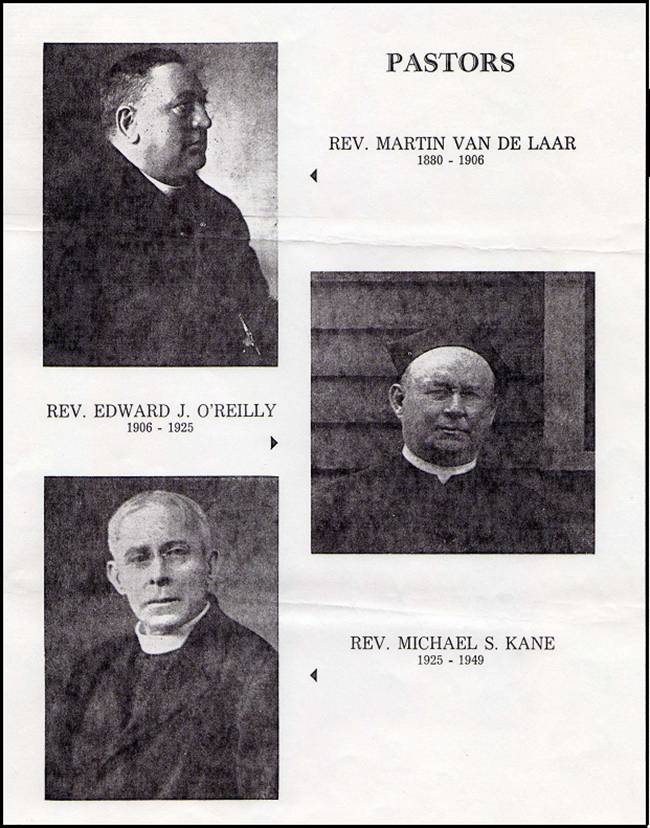
High and Grammar Schools. Father Van de Laar died on
February 21, 1906, after serving St. Patrick’s for
twenty-six years. The residents of South Chicago
paid tribute to this outstanding priest. One of the
unique tributes paid to him was a “street-car
funeral”to Mount Olivet Cemetery, which was a
tribute to the thrift and secular economy preached
by Father Van de Laar during his life time.
Father Van de Laar was, probably, as much
responsible as any man for developing the very close
cooperation –the brotherhood of man, between all
races and creeds in Sout Chicago. This spirit still
flourishes, and is very much in evidence in the
promotion and operation of St. Patricks Centennial
program
|
1906-1925 Faith Rekindled
In extricable enmeshed
are the growed and devel-opment of a community and its institutions.
Partic-ulary is this true of St. Patrick’s Church and South Chicago,
both strongly cohesive. The rising and ebbing economic tides of the
area have similarly affected the progress of St. Patricks Church. In
its formative years the church nurtured by Indus-trial and business
expansion whereas in later years it stability and existence have
been threatened by adverse economic conditions. The pastors of St.
Patrick’s Church proved to be as much builders and conservators of
the community as they were leaders and guardians of the spiritual
welfare of their parish-ioners.
When the Rev. Father Edward O’Reilly assumed the pastorate of St,
Patrick’s Church on March, 8 1906 a pall of gloom had settled over
South Chicago. Father O’Reilly faced a community stunned by the news
that the steel mills were moving to Indiana.
Greater Spiritual and Material
Growth
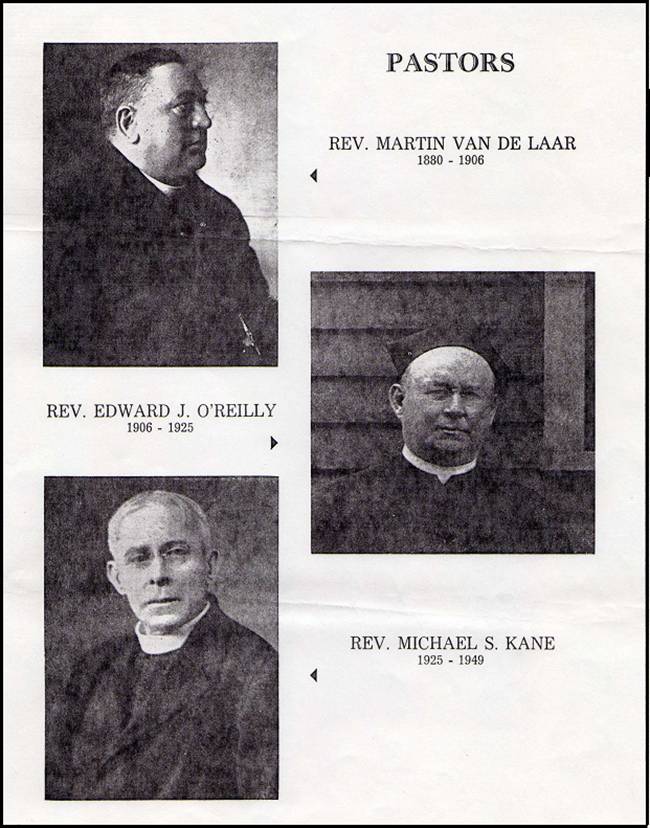
Father M. Van de Laar was appointed the first permanent
pastor of St. Patrick’s on February 1, 1880. This young
priest, born in Holland, was enthralled with the vision of
potential industrial development in his parish. His
ambitious plans for St. Patrick’s included that education,
under parish auspices, was the way the development of good
citizens, and local and national prosperity.
Through his inspiration and guidance, funds were raised to
elevate the church one story, with the new space to be used
as an elementary school. He was then successful in securing
the services of the Sisters of Mercy in organizing and
conducting the new parochial school, the first one in the
city of Chicago south of Old St. John’s at Eighteenth and
Clark Streets.
Since the formal opening of the school, in September 1883,
thousands of youngster’s have attended the school, and have
later played important roles in the life of the community,
and of the city, state and nation. Many priests and nuns,
and hundreds of business, industrial, professional, and
governmental leaders have reflected the splendid foundation
developed at St. Patrick’s.
Still another achievement an the field of education was the
opening in 1889, of St. Patrick’s High School. It thus
became the first Catholic High School in the City of Chicago.
Another innovation of this Dutch-born priest was the
addition of a required course in Irish history, because the
Irish formed the predominating racial group in the parish.
Thys, St. Patrick’s was perhaps the first high school in the
United Sates to add Irish history to its curriculum.
The good Father was intensely interested in the physical
welfare of his students. Many of them had to cross dangerous
railroad tracks, particularly the concentration of Baltimore
and Ohio, New York Central, and Pennsylvania tracks near 94th
Street and Commercial Avenue. Althought unable to obtain
track elevation, he did succeed in having a police officer
assigned to the dangerous crossing ….again, probably the
first time a Chicago policeman was assigned to safeguard
school children en the way to and from school.
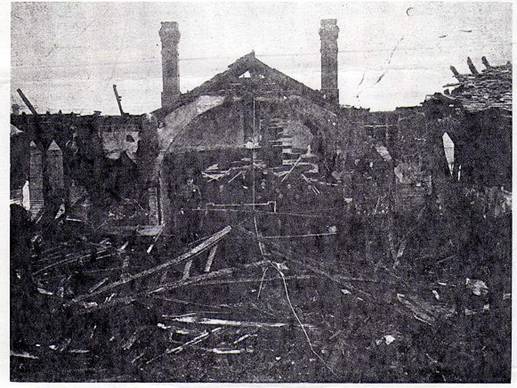
Fire destroyed the church-school in May 1902. The use of an
auditorium in a building at Ninety-first Street and
Commercial Avenue was secured. With characteristic energy
and resource fullness, St. Patrick’s parishioners, Father
Van de Laar, set rebuilding the church.
At first it was thought that the church be located further
north, because St. Kevin’s Church in South Deering was then
flourishing. However after much deliberation, Father Van de
laar made the decision to build on the site of the old
church. On July 9, 1903 Mass was celebrated for the first
time in the new St. Patrick’s church.
1871); but the faith of these
pioneers lives on today in Old St.Patick’s. Indeed, they were
not only mindfull of their own spiritual needs, but like the
Apostles, they helped, indirectly, to spread the gospel of all
what now is called Sout-East Chicago, because St. Patrick’s was
the parent church of South Shore, Windsor Park, Cheltenham,
East Side, Heewisch, and Pullham.
After serving the people of St. Patrick’s in their little church
later, the location of the original Bowen High School Father
Kelley participated as Chaplain in the Civil War, going too
battle with the famous North Illinois Regiment, affectionately
known as Mulligan’s Brigade.
Rev. T. Murphy succeeded Father Kelley. After a few years he was
followed by Rev. P.J. Conway, who served St. Patrick’s until
1866. In that year St. Thomas the Apostle parish was founded in
Hyde Park, and St. Patrick’s was attached to St. Thomas’ as an
out-mission, with Rev. Joseph Bowles in charge. Father Bowles
served until his death in 1870.
It is interesting to not that St. Patrick’s remained an
out-mission, without a permanent pastor, until 1870. In the
decade from 1870 to 1880 several priests served St. Patrick’s.
They included Rev. Thomas Leyden, Rev. P.M. Flannigan, and Rev.
D.A. Tighe, who served from 1875 to 1880, leaving to become
founder of Holy Angels’ Church.
The future of South Chicago did not appear too rosy during
Father Tighe’s time. There were no Steel Mills there. The steel
industry was looking to the waterways, the river and the canal.
The first large steel mill was built in the village of Cummings,
later the better known South Dearing. Naturally, the settlers in
Cummings were anxious to have a church further south in their
village.
Because he felt that South Chicago was destined to become a
ggreat steel making center, Father Tighe was reluctant, to
consider moving the church any great distance. In order to
satisfy both the Irondale and South Chicago parishioners, he
compromised by trading land with the Board of Education of the
Village of Hyde Park. In this deal, he acquired a small school
an another large school site on Commercal Avenue, just south of
Ninety-fifth Street (the present location of St. Patrick’s).
Energetic Father Tighe sold the church building to a buyer who
converted it into a hotel which was once characterized as the
“Waldorf-Astoria”of early South Chicago. The good Father
remodeled the old district school into a church, which was used
for several years. Father Tighe’s confidence in the future of
South Chicago was verified by the building of the North Chicaga
Rolling Mill Company plant (later to become the Illinois Steel
Co, then Carnegie Steel, and now U.S. Steel). Because of the
rosy outlook it was decided to give St. Patrick’s a permanent
pastor.
|